Wireless Charger Samsung Tab: Does Your Tablet Support It?
Not all Samsung Galaxy Tabs support wireless charging — and the product listings often don't make this obvious. Here's how to check your model and what to do either way.
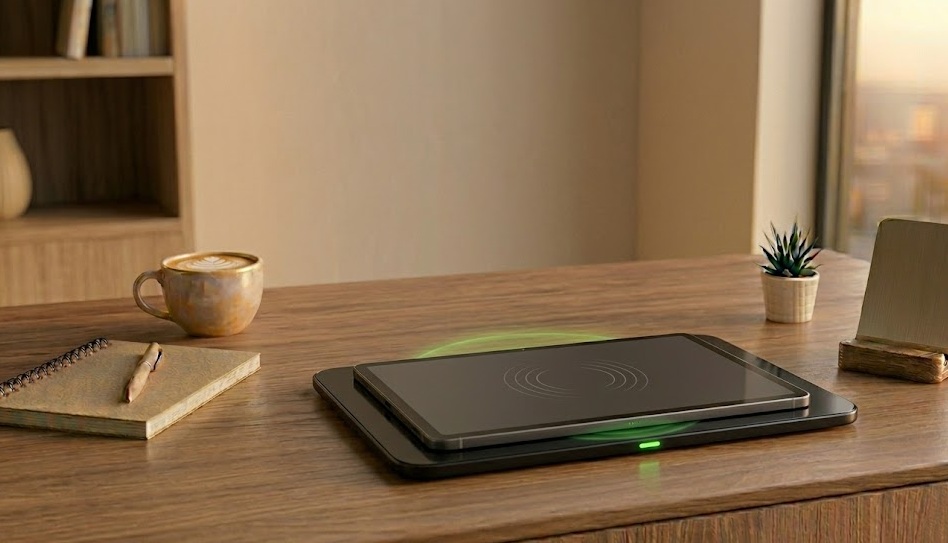
Only select Samsung Galaxy Tab S models support wireless charging — specifically the Tab S7+, S8+, S8 Ultra, S9+, S9 Ultra, and S9 FE. Most Tab A, Tab A7, Tab A8, and Tab A9 models do NOT support wireless charging. Check your exact model's spec sheet before buying a wireless pad.
What's in this guide
- Which Samsung Tabs support wireless charging
- Common problems
- Self-diagnosis checklist
- How to set up wireless charging on your Tab
- Why it's not working — fixes
- Diagnostic tool
- The most overlooked reason it won't charge
- What not to do
- When it's a hardware issue
- Decision flow
- If you only do one thing
- People also ask
Which Samsung Galaxy Tabs Support Wireless Charging
This is the first thing to verify — and Samsung's own marketing buries it. Here's the straightforward breakdown:
| Samsung Tab Model | Wireless Charging? | Max Wireless Speed |
|---|---|---|
| Galaxy Tab S9 Ultra / S9+ / S9 FE | ✅ Yes | 15W |
| Galaxy Tab S8 Ultra / S8+ | ✅ Yes | 15W |
| Galaxy Tab S7+ / S7 FE | ✅ Yes | 15W |
| Galaxy Tab S8 (standard) | ❌ No | — |
| Galaxy Tab S7 (standard) | ❌ No | — |
| Galaxy Tab A9+ / A9 / A8 / A7 | ❌ No | — |
| Galaxy Tab Active Pro / Active 3 | ❌ No | — |
Notice the pattern: wireless charging is limited to the "plus" and "Ultra" variants of the Tab S line. The standard Tab S models and all Tab A models use wired charging only. According to Samsung's official product specification pages, wireless charging is listed under "Battery" specs only for Tab S7+, S8+, S8 Ultra, S9+, S9 Ultra, and S9 FE models.[source]
Common Problems When Charging Samsung Tab Wirelessly
| Problem | Most Likely Cause | Fix Difficulty |
|---|---|---|
| Tab doesn't charge on any wireless pad | Your model doesn't support wireless charging | Easy to verify — check spec sheet |
| Charges slowly (3–4W instead of 15W) | Pad not Samsung-certified, or wrong USB-C adapter on pad | Easy |
| Charges on pad but gets very hot | Normal heat loss from induction + large tablet battery | Easy — fan or cool room fixes it |
| Intermittent charging (starts and stops) | Tab shifting off the coil center, or thermal throttle | Easy |
| Works on Samsung pad, not others | Some pads output lower wattage that the Tab's power management rejects | Medium |
How to Set Up Wireless Charging on a Compatible Samsung Tab
Step 1: Confirm your model is supported
Go to Settings → About tablet → Model number. Then cross-reference with Samsung's spec page for that model. Look specifically in the "Battery" section — if "Wireless charging" is listed with a wattage, you're good to go.
Step 2: Enable fast wireless charging
Go to Settings → Battery and device care → Battery → More battery settings → Fast wireless charging. Make sure this toggle is on. It's enabled by default but can be turned off after software updates.
Step 3: Use a compatible pad and adapter
For full 15W wireless on your Tab, use a Samsung-certified fast wireless charger pad (the EP-P5400 or newer), powered by at least an 18W (9V/2A) USB-C adapter. A standard 5W adapter limits even the best pad to around 5W. Samsung's official accessory documentation states that the 15W fast wireless charging speed requires their certified charging pads powered by compatible fast charger adapters (minimum 9V/1.67A).[source]
Step 4: Center the tablet on the pad
Tablets have larger wireless coils than phones, but alignment still matters. Most standalone wireless pads are phone-sized — the Tab's coil may extend beyond the pad's transmitter area. A larger wireless charging pad (or a multi-coil pad) gives much better results for tablets.
Common Problems and Fixes
Charging at 5W when it should be 15W
Check the adapter powering your pad first. Tom's Hardware testing shows that wireless pads only deliver their rated wattage when powered by a compatible USB-C adapter — plugging a 15W pad into a 5W adapter limits output to around 5W regardless of pad specs.[source] Use the Samsung adapter that came with your device, or any 25W USB-C PD adapter.
Tab charges intermittently
Large tablets don't sit as securely on small phone-oriented pads. The Tab shifts slightly during charging (from notifications making it vibrate, etc.) and loses contact. Either use a pad with a raised lip or a dedicated tablet wireless charging pad. A heavy case can also add enough grip to stop the Tab sliding.
Fast wireless charging toggle is missing
If you don't see the fast wireless charging option in Battery settings, your Tab model doesn't support it — only standard Qi charging is available even if the model is listed as wireless-capable.
Does your Samsung Tab show a wireless charging icon when placed on the pad?
What Not to Do
Don't assume your Samsung Tab supports wireless charging because your Samsung phone does. They have completely different hardware specs. Check the tablet's spec sheet independently.
Don't use a phone-sized pad and expect full speed. If the Tab's coil is larger than the pad's transmitter, energy transfer is inefficient. You might get 3W instead of 15W. Match pad size to device size.
Don't leave the keyboard cover on during wireless charging. This is the most common preventable cause of failed wireless charging on Samsung Tabs with official covers.
When It's Probably a Hardware Problem
If your Tab is a confirmed wireless-capable model, you've tried multiple Samsung-certified pads, removed all cases, and it still won't charge wirelessly — the wireless charging coil may be damaged. This can happen from hard drops or from previous unauthorized repairs. A Samsung service center or authorized repair shop can diagnose this in a few minutes.
Samsung Tab Wireless Charging Decision Flow
If You Only Do One Thing
Check the spec sheet before buying anything. Most Samsung Tabs do not support wireless charging, and it's frustrating to buy a wireless pad only to discover your specific model isn't compatible. Go to Samsung.com, search your model number, find the Battery section in the specs, and confirm "wireless charging" is listed. Two minutes of checking saves you from a trip to return a charger.
People Also Ask
Only select Samsung Tab S models support wireless charging — specifically the Tab S7+, S8+, S8 Ultra, S9+, S9 Ultra, and S9 FE. Most Samsung Tab A models and standard Tab S models do not. Always verify your exact model's spec sheet.
Any Qi-certified wireless charger works with compatible Samsung Tabs, but for full 15W fast wireless charging you need a Samsung-certified fast wireless charger pad powered by at least an 18W USB-C adapter.
Most likely your Tab model doesn't support wireless charging — check the spec sheet first. If your model does support it, try removing any keyboard/folio case, using a larger wireless pad, and ensuring the adapter powering the pad is at least 18W.
The standard Tab S8 does not support wireless charging. The Tab S8+ and Tab S8 Ultra do, with up to 15W wireless charging speed on compatible Samsung pads.